



E15 is not the way to deal with Trump’s gas price spike
E15 is gasoline with 15% ethanol, instead of the 10% blend that currently dominates the market via government mandate. In the past E15 has been banned during warmer months as it produces more environmental toxins then. Currently it’s being made available during the summer as Trump administration policy, and that may or may not be made long-term via legislation separate from the (on the whole, atrocious) Farm Bill recently passed by the US House.
With gas prices skyrocketing because of Trump, there is a new push for E15 based on consumer savings. From page 14 of a report prepared for the Minnesota Bio-Fuels Association:
As seen in Section 4.1.5, DIS analysis estimated that since 2013, Minnesota consumers have saved nearly $80 million due to the lower cost of E15 when adjusted for energy. Of the total savings, 57% of that occurred in 2023 and 2024 where consumers saved over $44 million. In 2023, consumers saved over $20 million and in 2024 consumers saved $24 million.
And therefore year-round E15 would be a wonderful thing. I and many others beg to differ, strenuously. Indeed, vehemently.
The report makes a very big deal of impressive-looking overall numbers. Let’s look at actual savings per consumer, on a comparative basis. When I filled up at a nearby gas station last week, regular unleaded (10% ethanol) was $4.09/gal, and E15 was $3.84, for a difference of a quarter a gallon. Suppose someone drives her 20 miles-per-gallon vehicle for a 40 mile round trip to her job every workday. Using two gallons of gas for that every day she’d save fifty cents a day. That is, about a 6% savings with gas where it is now. Not total “chump change,” I suppose, as every penny can add up for the frugal. But:
Here’s where EV owners win out. Going electric means you get to skip pricey trips to the pump, which is one of the biggest draws for making the switch. A 2018 study by the University of Michigan’s Transportation Research Institute found that the average cost to fuel an electric car was $485 a year, compared to $1,117 for a gas-powered vehicle. A 2020 Consumer Reports study similarly showed that EV drivers tend to spend about 60 percent less each year on fuel costs compared to drivers of gas-powered cars.
(NRDC)
60 percent versus 6 percent. I get that not everyone can “go electric” right away. But the point stands that E15 is not the way to go. Especially when you look at the bigger picture. Which is that it’s entirely accurate to label ethanol fuel “the worst natural resource decision in American history.” This map, from the Minnesota Pollution Control Agency, shows impaired waters in red.
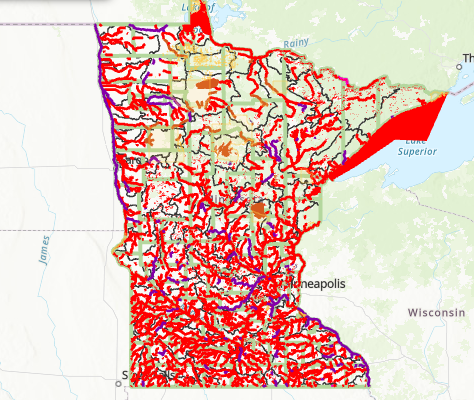
Particularly note the density of impaired waters in southern Minnesota, where “King Corn” rules. Iowa is just as bad. That much water having been rendered toxic to most forms of biological life, including human, ranks these areas with the most polluted regions on earth. Meanwhile, Big Ag pressures farmers to overapply the primary culprit in this, nitrate fertilizers.
Estimates of how much of US corn production goes for ethanol fuel average around 40%. Suppose that 40% of the land currently devoted to corn was allowed to, in the standard phrase, “revert to nature.” Consider how that would mitigate, and quite possibly reverse, the ongoing declines in populations of birds, insects, and pretty much everything else that walks, flies, crawls, and/or swims. Farmers could be compensated with expanded CRP eligibility and payments, and therefore by a lot less ongoing financial pressure. And if Big Ag’s economic and political power is diminished – not a given, but certainly possible – so much the better.
Comment from Mac Hall: Finstad has repeatedly promoted E15 and yet the bills (HR 1346 Nationwide Consumer and Fuel Retailer Choice Act of 2025 and HR 4864 Ethanol for America Act of 2025) have not gotten a floor vote. They tried to get it added to the recently passed Farm Bill but the Ag Committee did not have jurisdiction.
Makes me wonder if this is politically smart for ethanol advocating Representatives … cost of food and gas is going to be a major issue in the election and with the Farm Bill having passed the House, what do these Reps have to campaign on ? The E15 issue would help them send farmers to the election booths rather then spending Election Day harvesting … plus getting more campaign contributions for the ethanol industry (plus corn producers.)
BTW … I am not convinced that without the November election that the Senate would pass a new five-year Farm Bill but instead just put another one year extension on the 2018 program.
Last comment … great write up.
Thanks for your feedback. If we like what you have to say, it may appear in a future post of reader reactions.