

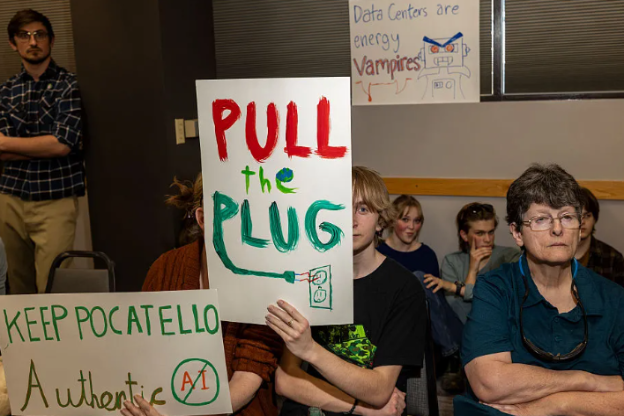

AI continues to do more harm than “good”
People are paying, and they’re not getting any positives in return.
America’s largest power grid is under enormous strain from AI data centers. And a new report details how wholesale electricity prices have jumped nearly 76% in an area where tens of millions of Americans live.
PJM Interconnection operates a wholesale electric power market in the mid-Atlantic, Midwest, and South that covers 67 million people in 13 states (Delaware, Illinois, Indiana, Kentucky, Maryland, Michigan, New Jersey, North Carolina, Ohio, Pennsylvania, Tennessee, Virginia, and West Virginia). That’s nearly 20% of the U.S. population, and it’s also an area with a lot of data centers.
Power prices there averaged $136.53 per megawatt-hour in the first three months of 2026, according to a massive new report from Monitoring Analytics. That’s up from $77.78 per megawatt-hour in the first three months of 2026. The report isn’t shy about where we should put the blame: “Data center load growth is the primary reason for recent and expected capacity market conditions, including total forecast load growth, the tight supply and demand balance, and high prices.”
(Gizmodo)
And there’s this.
A single chatbot query hits a GPU, generates a response, and the computation ends. An AI agent doing the same job might run for hours, spawning sub-agents, calling APIs, querying databases, and looping back through the model dozens of times before producing a result.
A study published in April by researchers at Stanford’s Digital Economy Lab found that agentic coding tasks consume 1,000 times more tokens than standard code reasoning and chat, a finding that puts hard numbers on a cost problem the AI industry is only beginning to confront.
(Quartz)
You’d think the self-styled greatest, most essential geniuses of our time, whose tremendous, life-changing products we’re all supposed to uncritically embrace with full-blown worship, could figure out how to run them on a lot less energy and plagiarized “memory.” It’s probably Chinese AI researchers, who have been starting to kick Silicon Valley’s ass in general, who will do that. And many of the data centers will end up being useless hulks.
I’m not sure about this, which is about some evidence of job losses in AI-exposed occupations. Clearly plenty of places are trying to blame AI for cuts rather than acknowledge that Trump’s pitifully stupid economic and other policies have at least as much to do with them. And so far AI is falling way short of its propagandists’ claims about how much it can really do. That said, it definitely is having a growing impact in some areas, like tech and commercial arts.
For an example of propagandists’ claims falling short:
FarmWise is one of nearly 20 agtech startups around the world forced to cease operations in 2025, according to a new University of Nebraska-Lincoln white paper. Authors Ankit Chandra and Ishani Lal blamed a “cost adoption mismatch” between expensive and complex agricultural tech and what farmers can reasonably afford and incorporate into daily operations.
(Offrange)
Talk about being too hung up on yourselves and not knowing your customers. Which given the egos involved is entirely unsurprising.
I still find myself always getting back to: When has Big Tech ever come even close to living up to the hype? Did just-in-time manufacturing lead to floods of great products everyone can afford? Has social media brought together folks worldwide and thereby led to world peace? Has surveillance technology ended crime? Has tech in schools produced a generation of geniuses? Has virtual reality brought humanity an endless stream of fascinating and enlightening adventures? Has the internet itself really changed the world for the better (though I’ve certainly benefited from it)? Maybe this time it will be different but I have to see a great deal more, and I still very much doubt that I will. Meanwhile too many of our tech overlords are still doing what they can to keep the likes of Trump in power, and fighting any kind of regulation.
Comment from Joe Musich: And therein lies the rub…Right-O Hammy…”Meanwhile too many of our tech overlords are still doing what they can to keep the likes of Trump in power, and fighting any kind of regulation.” Let’s put scientists back in science.
Thanks for your feedback. If we like what you have to say, it may appear in a future post of reader reactions.