
How did the polls miss so badly on Flanagan/Craig?
I’m an early to bed early to rise type, and while I’m neither wealthy nor wise, I do enjoy excellent health. I went to bed the night of the primary election, before any results started being reported in Minnesota, kind of confident that Lt. Gov. Peggy Flanagan, for whom I’d voted earlier that day, would win, but by no means highly confident. So when I woke up around 2AM, as often happens, I had to get up and see before there was any chance I’d get back to sleep. Of course I was delighted that Peggy had absolutely crushed it, but also a little irked that I’d had to deal with nervousness during the day because of bad polling. (I was also pleased that Trina Swanson won here in MN-08. But mildly disappointed that we don’t get to enjoy the hilarity of Mike Lindell in the general.)
The polls for the Wisconsin race were off by roughly 20 points—about the same amount they were off in Minnesota (though in that case, they underestimated the progressive Flanagan), and in the Michigan race last week. Clearly, something is rotten in the state of cellphone autodialers. Polling primaries was tough business even 30 years ago when everyone had a landline and calls from strangers were not 95 percent spam, because one has to gather data and then estimate how many people are actually going to turn out. That can vary wildly depending on the state, the party, whether it is a competitive race, the national environment, and so on.
Incidentally, the vaunted prediction markets also completely flubbed this one. They couldn’t even sort out who was likely to win when votes started coming in and the political pros could guess with increasing accuracy who was likely to win based on where the remaining votes were located. They were quite obviously just swinging wildly back and forth with the headlines. It turns out markets are not some infallible distillers of Truth from the celestial ether.
(The American Prospect)
Actually, that remark about Minnesota isn’t entirely correct. Two SurveyUSA polls for KSTP showed the race (supposedly) being tight, but a PPP poll for the Democratic Lieutenant Governors Association, which backed Flanagan, had her up by 14. So we’re really only talking two polls from the same pollster that stunk it up.
My initial thought was that here in Minnesota the progressive equivalent of Trump’s “hidden voters,” so-called because they’re not the type to ever bother with responding to pollsters on the phone or online, and who don’t show up for every election, had a lot to do with it. But that doesn’t explain Wisconsin and Michigan. Also, Trump’s hidden voters are only a few percent, just enough to have put him over the top in 2016 and 2024. The misses here are way higher than that.
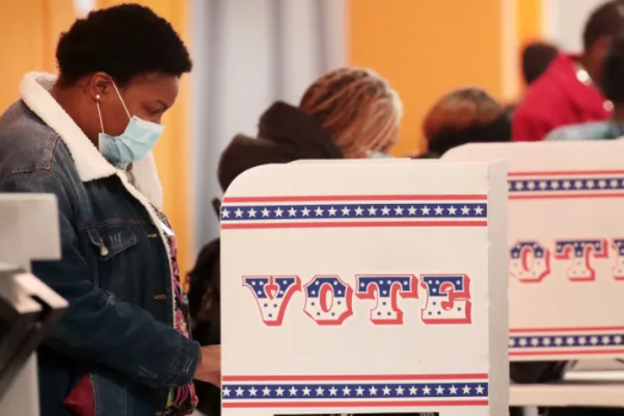
I think the Prospect article is pretty much right when it goes on to note that overall turnout was much higher than the pollsters probably expected. As a general rule they tend to try to play it safe, especially these days when it’s clear just how hard, if not impossible, really representative samples are to get. We’ll see how they do in November.
Comment from Joe Musich: Yes, delighted Flanagan excelled. But I fear there might have been some maga voting as Dems. But the moment of silence brought down the magas everywhere in my mind. The Dems have a chance to use the rule of law argument and they sure as shite should. As I’m originally from the Range I certainly am pulling for Trina Swanson but to review, and correct me if I am wrong, the total of the two magas was greater than her overall numbers. Of course I hope I am incorrect.
Reply from Dan Burns: For the DFL in MN-08, Trina had 54413 votes, John Munter had 4149, and Luke Gulbranson had 11888. There had been speculation that since Luke is some kind of TV star or something like that his name recognition might have made him competitive. The DFL vote total is 70450. On the Party of Trump side Stauber had 58139 and Anthony Hamilton 9121, for 67260 total.
Reply from Joe Musich: Thanks Dan. Thanks are looking very much brighter already. Very much appreciated. The three Ranges citizens need to sink their teeth into who is really hurting the families up there.
Comment from Mike: Brad Slager of Mediaite has a story out that pollster Median Strategies was an experement to see how fake polls spread through the media. Or so they say.
They have admitted they are putting out fake polls and have shut down operations. Median Strategies had the Wisconsin poll showing Hong up by 20 points, and Karen Bass up by double digits for LA Mayor.
Republicans have used fake pollsters before. Mitt Romney saw that Minnesota was lost, but thought he had a chance in Wisconsin. The problem was that to cover western Wisconsin you have to use the big transmitters in the Twin Cities.
To justify spending money in 2012 Minnesota, Romney hired a small polling firm (maybe MNB Research) to put out a poll showing him in a statistical tie with Obama in Minnesota. Not at all true, but a fig leaf to use to cover his real goal of blanketing Wisconsin with ads.
Reply from Dan Burns: Back when I was much more of a polls junkie it seemed to me pretty clear that while SurveyUSA tried to get theirs right when election days approached, when those were still a ways off they’d give conservative clients (like KSTP) the numbers they wanted to pimp. I can’t prove that, though. And it wouldn’t explain why their polls referenced in this story were so embarrassingly off.
Thanks for your feedback. If we like what you have to say, it may appear in a future post of reader reactions.